
AHA PALS Provider (Hands-On Skills Session)
Practical pediatric case evaluations and hands-on resuscitation checkouts for clinicians who completed the official AHA HeartCode® PALS online course. Low-stress, expert-guided skills verification.
How AHA PALS Blended Learning Works
Master pediatric case simulations online at your own pace, then demonstrate systematic assessment and practical interventions in person.
Complete Online Part 1
Complete the interactive, self-paced HeartCode® PALS online module at elearning.heart.org. Print or screenshot your official Certificate of Completion.
Online course sold separately by AHA and available for purchase during registrationHands-On Skills Verification
Attend your scheduled ~1-hour practical checkout in Chino or Hesperia. Demonstrate pediatric BLS CPR, airway support, IO/vascular concepts, and systematic case management.
Book your session below ($130.99)Receive Your Same-Day eCard
Your official American Heart Association PALS Provider 2-Year eCard is claimed and issued to your email the exact same day you pass checkout.
100% Hospital & Board AcceptedSchedule Your PALS Skills Session
Select your preferred location (Chino or Hesperia) to view live appointment availability.
 ✓ Identical to Full Classroom Credential
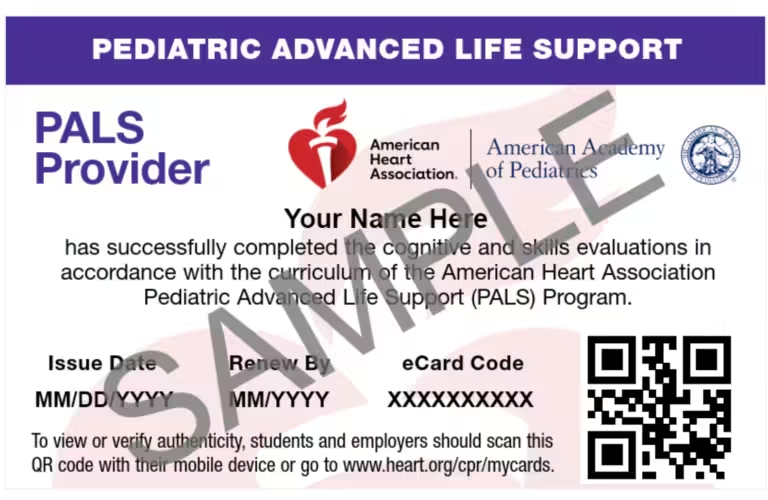
Your Same-Day AHA PALS Provider eCard
The eCard awarded through an in-person HeartCode® skills verification checkout is 100% identical to the credential earned in a traditional full-day classroom course. There is no distinction on your card.
-
Instant Digital Delivery: Access and save your official AHA PDF certificate directly from your phone or computer on the same day.
-
Secure QR Code Verification: Features an AHA verification QR code allowing pediatric hospital credentialing departments and licensing boards to instantly verify authenticity.
-
Full 2-Year Validity: Universally recognized nationwide across children's hospitals, emergency departments, PICUs, NICUs, and EMS agencies.
Skills Tested During Your Session
Our experienced critical care instructors guide you through equipment setup and scenario expectations before evaluating your stations.
High-Performance Child & Infant BLS CPR
Demonstration of high-quality child and infant chest compressions, 15:2 two-rescuer coordination, rapid AED pad placement, and proper depth feedback.
Pediatric Bag-Mask Ventilation & Airway Adjuncts
Airway Management, achieving an airtight mask seal, and delivering effective ventilations without gastric inflation.
Systematic Pediatric Assessment (Evaluate-Identify-Intervene)
Applying the Pediatric Assessment Triangle (PAT), identifying respiratory distress vs. failure, and differentiating compensated vs. hypotensive shock.
Pediatric Cardiac Case Management & Pharmacology
Identification of symptomatic bradycardia, SVT vs. sinus tachycardia, verbalizing correct weight-based drug dosages, and pacing or cardioversion mechanics.
Frequently Asked Questions
Does the $130.99 fee include the AHA online course?
No. The $130.99 fee covers your hands-on manikin equipment, instructor evaluation, and official same-day eCard processing at our facility. The online course (HeartCode® PALS) is purchased separately through the AHA portal (elearning.heart.org).
What do I need to bring to the session?
You must bring a printed copy or digital screenshot of your AHA HeartCode® PALS Certificate of Completion. Instructors cannot legally test you without verification that Part 1 was finished.
What if I make a mistake on a drug dose or algorithm?
Rescue CPR provides a supportive, low-stress coaching environment. If you hesitate on a weight-based dose or scenario branch, our instructors coach you through the protocol and allow you to re-demonstrate the case until you feel confident and meet the AHA standard.
Can I combine this with a BLS or ACLS skills session?
Yes. If you also complete HeartCode® BLS or HeartCode® ACLS online, contact us or book consecutive appointments to finish multiple checkouts during the same visit.
AHA Disclaimer: The American Heart Association strongly promotes knowledge and proficiency in all AHA courses and has developed instructional materials for this purpose. Use of these materials in an educational course does not represent course sponsorship by the AHA. Any fees charged for such a course, except for a portion of fees needed for AHA course materials, do not represent income to the AHA.