
AHA Pediatric Advanced Life Support (PALS)
Systematic pediatric assessment, emergency pharmacology, and advanced resuscitation scenario training for healthcare providers responding to emergencies in infants and children.
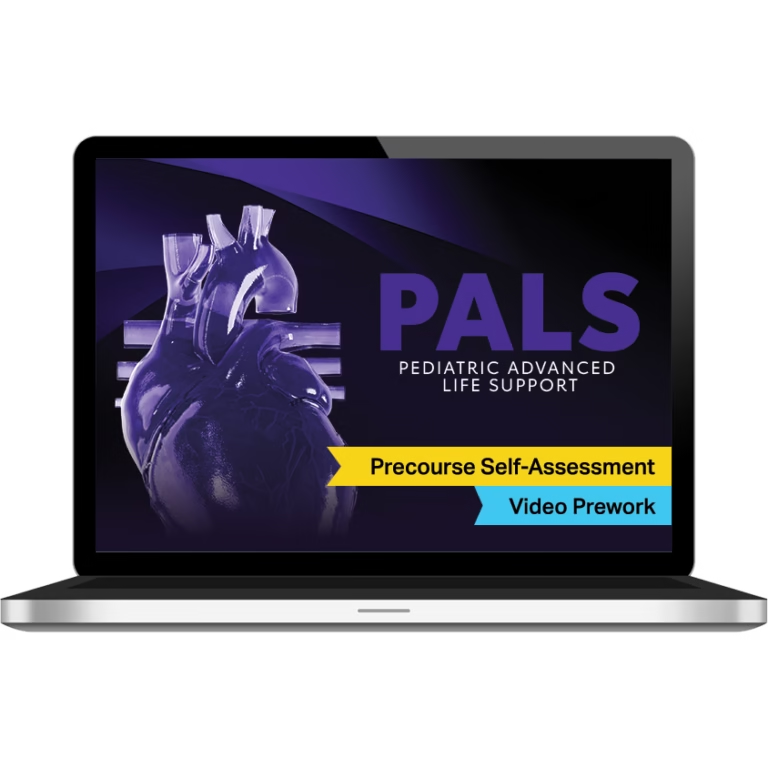
Complete Your Free Precourse Self-Assessment & Work
The American Heart Association requires all PALS students (Initial and Renewal) to complete the official PALS Precourse Self-Assessment and Precourse Work before attending class. This free online module prepares you for pediatric rhythm recognition, respiratory distress/failure identification, and pediatric emergency pharmacology.
- Score 70% or Higher: You may retake the self-assessment modules as many times as needed to pass.
- Bring Your Certificate: Print or screenshot your completion certificate to present to your instructor upon arrival.
- Cost: 100% Free through the official AHA student portal.
Choose Your Location & Session
Select your preferred training facility (Chino or Hesperia) to view live seat availability for PALS Initial and Renewal courses.
 ✓ 100% Hospital & Medical Board Accepted
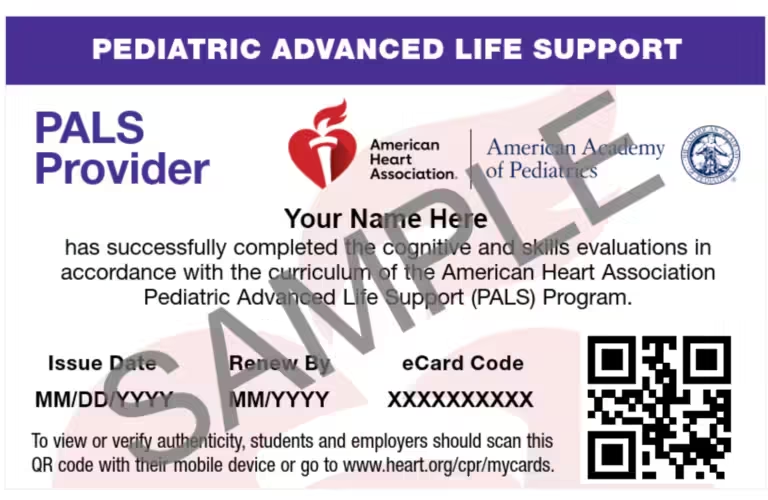
Your Official AHA PALS eCard Issued Same Day
Never miss a clinical shift, pediatric travel contract deadline, or hospital credentialing window waiting on mail delivery. Immediately following course completion, your official AHA certification is processed digitally.
-
Instant Digital Delivery: Access, save, and print your official AHA PDF certificate directly from your phone or computer on the same day.
-
QR Code Verification: Features a secure AHA QR code allowing hospital credentialing coordinators and nursing boards to instantly verify license authenticity.
-
Valid for 2 Full Years: Universally recognized nationwide by children's hospital networks, trauma centers, surgery centers, and EMS transport agencies.
Who Needs AHA PALS Certification?
Designed for healthcare personnel who care for pediatric patients in emergency, intensive care, inpatient, and prehospital settings.
Pediatric & PICU / NICU Clinicians
Pediatric hospitalists, PICU/NICU physicians, pediatric emergency medicine clinicians, and pediatric nurse practitioners.
ED, Floor & Recovery Nurses
RNs working in emergency rooms, urgent care centers, pediatric surgical recovery units, and pediatric inpatient floors.
Paramedics & Transport Teams
Field paramedics, pediatric critical care transport crews, flight nurses, and EMS emergency response clinicians.
Anesthesia & Procedural Teams
Pediatric anesthesiologists, CRNAs, pediatric dentists, oral surgeons, and outpatient sedation recovery clinicians.
PALS Course Curriculum & Clinical Competencies
Hands-on scenario practice focused on the systematic Pediatric Assessment Triangle, early stabilization, and team-based resuscitation.
Systematic Pediatric Assessment
Rapid evaluation using the Pediatric Assessment Triangle (PAT), primary ABCDE assessment, focused secondary examination, and diagnostic evaluation.
Respiratory Distress vs. Respiratory Failure
Differentiating upper vs. lower airway obstruction, lung tissue disease, and disordered control of breathing, with appropriate oxygen and BVM therapy.
Pediatric Shock Classification & Fluid Resuscitation
Rapid recognition of hypovolemic, distributive (septic), cardiogenic, and obstructive shock; vascular access (IV/IO) and fluid bolus protocols.
Pediatric Arrhythmias & Electrical Therapy
Recognition and management of symptomatic bradycardia, SVT vs. sinus tachycardia, VT with pulses, vagal maneuvers, and weight-based electrical therapy.
Cardiac Arrest Algorithms & Pharmacology
High-quality child/infant BLS integration, shockable (VF/pVT) and non-shockable (Asystole/PEA) algorithms, epinephrine, amiodarone, and lidocaine dosing.
Effective Resuscitation Team Dynamics
Structured closed-loop communication, clearly defined team roles, avoiding chest compression interruptions, and post-cardiac arrest ROSC care.
Frequently Asked Questions
What is the difference between PALS Initial and Renewal?
The Renewal course (~3 hours) is designed for clinicians holding an active or recently expired PALS card who already understand pediatric algorithms and assessment models. The Initial course (~3-4 hours) provides comprehensive instruction, in-depth drug calculation and sizing reviews, and guided pediatric megacode practice for first-time students.
When do I receive my official PALS eCard?
Your official American Heart Association PALS Provider 2-year certification eCard is issued on the very same day of your class. You can download and share your official digital credential immediately.
Do I need to hold a separate BLS card?
PALS assumes solid mastery of high-performance Basic Life Support skills. While not mandatory to attend, most hospital facilities require both credentials. You can also add a same-day BLS renewal during your PALS session.
Do I receive Continuing Education (CE) credits?
Yes. Physicians, Nurses*, and Paramedics/EMTs in California can receive official CE contact hours upon completion of either the Initial or Renewal course. *Nursing CE contact hours are awarded through completion of the AHA Precourse Work module.
AHA Disclaimer: The American Heart Association strongly promotes knowledge and proficiency in all AHA courses and has developed instructional materials for this purpose. Use of these materials in an educational course does not represent course sponsorship by the AHA. Any fees charged for such a course, except for a portion of fees needed for AHA course materials, do not represent income to the AHA.